Chudamani Raghavan (Ār. Cūṭāmaṇi)
Biography
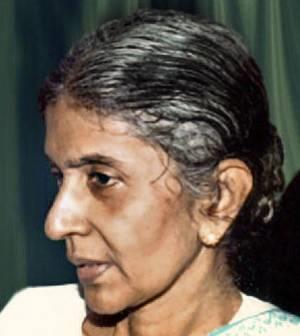
Chudamani Raghavan was born on 10 January 1931 in Chennai, the capital of the South Indian state of Tamil Nadu. She grew up in a Brahmin family as the third daughter of Thiru Raghavan, an official in the Indian Civil Service (District Collector of Chennai).
Because of a physical disability, she was not sent to school but was taught at home — initially by her elder sister, who from an early age recommended books to her and introduced her to classical literature, and later by private tutors. She went on to educate herself continuously and, encouraged by her mother Kanakavalli, who was a painter, began writing and painting quite early on. Her younger sister, Rukmini Parthasarathy, later also began writing and likewise made a name for herself as a writer.
Following an entertaining satire already published in 1954 in the Tamil weekly Tinamani Katir, 1957 saw the publication of Kaviri, Chudamani Raghavan's first ambitious short story, which won the Kalaimagal Silver Jubilee Award. In 1960 came her first novel, Manattukku iniyavaḷ, which won the Narayanaswami Iyer Memorial Award of the Tamil magazine Kalaimakal. In 1961 she further won the Ananda Vikatan Award for her play Iruvar Kandanar.
Work
Over the course of a life marked by suffering, she published a total of 32 books — collections of short stories, plays and novels. Her preferred literary form was the short story. In all, she wrote more than 600 short stories, several of which she also translated into English and published in magazines (Femina, Pratibha India, Manushi, Women's Era, among others) as well as in anthologies (Glimpses. Modern Indian Short Stories (1992), Penguin Books (2004), among others).
Her short stories, written in her mother tongue Tamil, appeared in 19 collections, among them, to name just a few: Oliyin mun (1959), Cirukataikal (1978), Cuvarotti (1985), Amma (1987), Kinaru (1991), Astamanak kolankal (1993).
Among her novels, the following deserve mention: Pinju mukam (1959), Punnakai punkottu (1965), Iravuccutar (1974, translated into English under the title Yamini, 1996).
In the year of her death, the renowned Tamil writer Dilip Kumar published Nagalinga maram (Adaiyalam), a collection of selected stories. Two further collections followed, each containing more than 50 stories: Thanimai Thalir (Kalaichuvadu, 2013) and Innoru Murai (Kavita Publications, 2017).
In 2015 the first collection of her stories translated from Tamil into English by Prabha Sridevan then appeared, titled Seeing in the Dark, Short Stories by R. Chudamani (Oxford University Press).
The following year, Chudamani Raghavan's legacy found expression on stage, when the renowned English-language theatre group Madras Players presented seven of her stories under the title Chudamani.
In 2021 the South Indian director Gnana Rajasekaran paid tribute to Chudamani's work with Ainthu Unarvugal, a film adaptation of five of her short stories.
Besides the awards already mentioned, Chudamani Raghavan was honoured with the Ilakkiya Chintanai Award, the Tamil Sangam Award and the Tamilnadu Government Award.
Chudamani Raghavan died on 13 September 2010 at the age of 79. She is regarded as the only author among the Tamil women writers of her time whose work was consistently classed as literary rather than didactic, sentimental, or purely entertainment-oriented.
In fulfilment of the provisions set out in her will, her entire estate went as a donation to relief organisations such as the Ramakrishna Mission Students' Home, the Ramakrishna Math Charitable Dispensary, and Voluntary Health Services.
The distinguished writer C. S. Lakshmi, who writes under the name "Ambai" and who founded SPARROW (Sound & Picture Archives for Research on Women), a non-governmental organisation, in 1988 and has directed it ever since, wrote the following about Chudamani Raghavan's body of work in her obituary "Loss of a Crest Jewel", published in "The Hindu" on 2 October 2010:
"The core concern of her stories remained till the very end, human life as it is lived in the present day. Women in her stories emerge as characters bracing the strong winds of life, fighting and resisting and sometimes succumbing. Sometimes it seemed as if her characters had exaggerated emotions but it was more than made up by the earthiness she gave them and by the lyrical and poetic language in which she painted them, which caught the subtlest of emotions with ease and dexterity."
Dieter B. Kapp
(updated by Hem Mahesh on 8 December 2021)
Published in German
- Der Nagalinga-Baum, translated from the Tamil and edited by Dieter B. Kapp, Draupadi Verlag 2017 (in German)
- Zwei Welten, translated from the Tamil by Hem Mahesh, Lotos Werkstatt 2021 (in German)
Excerpt
- Excerpt from "Der Nagalinga-Baum" (in German)
Reviews
- Review of "Der Nagalinga-Baum", published in SÜDASIEN 3/2017 (in German)
- Review of "Zwei Welten", published in SÜDASIEN 4/2021 (in German)
Further Links
- Obituary for Chudamani Raghavan in "The Hindu", 2 October 2010
- Chudamani: stage adaptation of her short stories by the Madras Players (The Hindu)
- Writer Chudamani's women come alive on celluloid in Ainthu Unarvugal (The Hindu)
📄 Download this author profile as a PDF (in German)