Manuka Wijesinghe
Life
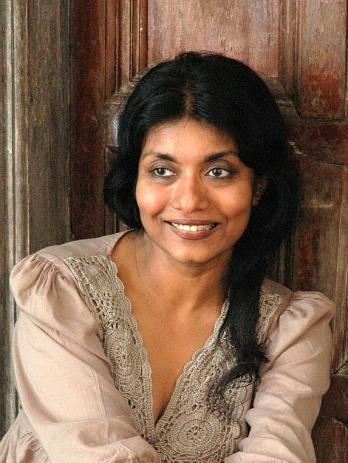
Manuka Wijesinghe (born 1963 in Colombo, Sri Lanka) has to date established herself as a writer with four plays, a volume of poetry and short prose, and four novels.
Her love of literature and enthusiasm for creative work were instilled in her at home, as the daughter of a book-loving engineer and an art teacher. Her mother tongue is Sinhala, but she attended an Anglican school and writes predominantly in English. She later studied drama at the University of Maine, USA. She also has an intense relationship with Spanish language and literature, which she discovered as a student. She felt particularly drawn to the magic realism of Latin American authors — an influence that can be recognised in her novels. Before publishing her own literary works, she had already drawn attention to herself in Colombo as a dancer and actress. Today she lives in Sri Lanka and Germany, is married, and is the mother of two grown children. She has also completed training in traditional healing methods and runs a private practice.
Literary Work
1. Plays:
Prompted by her love of the stage and her acting career, Manuka Wijesinghe began writing plays of her own. Her one-act plays Mad Cow, Flight 582 to Zurich, Marital Disadventure, and The Affair were performed in Colombo but have not been published in print. Summaries of their content (in English) can be read at manukawijesinghe.com.
2. Poetry and Short Prose:
Silhouettes for Justice (Colombo, 1994). The poems in this volume represent a very personally inflected engagement with the atrocities of the civil war in Sri Lanka. It also contains two short stories written in the USA, in which the influence of magic realism is already discernible.
3. Novels:
The novels Theravada Man (Colombo: Bay Owl Press, 2009), Sinhala Only (Colombo: Vijitha Yapa Publications, 2014), and Monsoons and Potholes (Colombo: Perera Hussein Publishing House, 2006) together form a trilogy centred on the family of a village schoolmaster. The family is followed across three generations, as Sri Lanka is part of the British Empire and, later, as an independent republic subject to changing governments and ideologies. The novels engage satirically and critically with the national-religious ideology that, after the end of colonial rule, led to the instrumentalisation of Buddhism by clergy and politicians, to the discrimination of religious and linguistic minorities, and ultimately to civil war.
Like Moths to a Flame, Colombo: Vijitha Yapa Publications, 2022. The full title, In the Name of Parents I Accuse the State for Sending Our Children Like Moths to a Flame to Die, points to the novel's central theme: the long-running violent conflict between Sinhalese and Tamils in Sri Lanka, for which, in the author's view, the government bears principal responsibility through its one-sided favouring of the Sinhala language and culture.
Reinhold Schein
Published in German
- Ein Mann des Mittleren Weges, Draupadi Verlag, Heidelberg 2019 (the first part of the trilogy) (in German)
Further Reading
- "Plural Narratives of the Sri Lankan Nation in Manuka Wijesinghe's Theravada Man", Isabel Alonso-Breto, Department of Modern Languages and Literatures and English Studies, Universitat de Barcelona
- "Rewritings of the Jātaka Tales in Colonial and Postcolonial Texts. A Fictional Evaluation of Buddhism in Postcolonial Sri Lanka: Manuka Wijesinghe's Trilogy", Geetha Ganapathy-Doré
Reviews
- On Ein Mann des Mittleren Weges: Review by Gerhard Klas on WDR5 (in German)
- Review by Thomas Kohl in Fachbuchjournal (in German)
- On Monsoons and Potholes: academia.edu
- On Sinhala Only: manukawijesinghe.com
- On Like Moths to a Flame: island.lk
Author's Website
Excerpt
- Excerpt from Ein Mann des Mittleren Weges (in German)
📄 Download this author profile as a PDF (in German)