Mrinal Pande
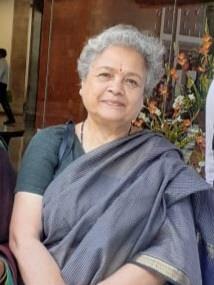
Mrinal Pande (born 1946) is a public intellectual, writer, journalist and editor all at once. In English and Hindi, her commentaries and columns regularly engage with social, cultural and political debates. To older generations her face is familiar not least as a news presenter for the state broadcaster Doordarshan and later STAR News. In 2006 she received India's high state honour, the Padma Shri, in recognition of her services to Indian journalism.
A feminism that transcends all particular interests is a fundamental concern of hers — perhaps more than anything else. Her advocacy with the pen is devoted to women of all classes, religions and social ranks. Known (and attacked) works include The Subject is Woman (1991) and her taboo-free engagement with female sexuality in Stepping Out · Life and Sexuality in Rural India (2003). At the same time, Mrinal Pande emphasises in interviews that she does not want to be reduced to feminism, and indeed her range is broad. An important theme for her, for instance, is the divisions within society between rich and poor, Hindus and non-Hindus, and city and countryside. The Other Country: Dispatches from the Mofussil (2012) deals with the contrasts between the metropolitan-shaped India and the often romantically idealised or dismissively condemned Indian countryside with its villages and small towns, where the majority of the population still lives.
Life and Career
Mrinal Pande was born under British colonial rule, but grew up in the young India of the years following independence. Her critical thinking developed not least as a critique of that era's rhetoric of progress. Her love belonged to language and literature — and for her the language of the colonial rulers, English, and Hindi were not mutually exclusive options but, on the contrary, both worlds attracted the young woman.
Crowning her studies — begun in Nainital (Kumaon, Uttarakhand) — was a master's degree in English from the University of Allahabad. She then taught first at her alma mater, and later at the state universities in Bhopal and Delhi. In 1980 she decided to give up her academic career and switch entirely to journalism. She recently addressed the history of Hindi journalism in a much-discussed publication (The Journey of Hindi Language Journalism in India: From Raj to Swaraj and Beyond, 2022).
For years Mrinal Pande was editor of the magazines Vāmā (1984–1987) and Saptāhik Hindustān for the Times of India Group. In 2000 she became editor-in-chief of Hindustan, one of the leading Indian Hindi-language daily newspapers. She became the first woman to serve as General Secretary of the Editors' Guild of India. At the same time she built up an association of women editors and journalists, the Indian Women's Press Corps. After retiring in 2009, she served from 2010 to 2014 on the board of Prasar Bharati, India's state media consortium. To this day she writes a regular column in The Indian Express.
Her revered teacher of Hindi literature was her mother, Gauri Pant (1923–2003), who since the 1950s, under the pen name "Shivani", had become one of the pioneers of women's writing in Hindi literature. This mother is one of the strong women in her book Devi: Tales of The Goddess in our Time (2000). Mrinal Pande herself edited a two-volume collection of her mother's short stories (Sampūrṇ kahāniyāṃ, 2018).
Work
Among the collections of her numerous short stories are the recently published Cār din javānī terī (2019) and Māyā ne ghumāyo (2021). She is also known for her versions of folk literature from Uttarakhand rendered in modern standard Hindi, some of which have found their way into Indian school textbooks. Among her novels, Viruddh ("Against") and Sahela re ("Oh, My Friend!") are considered her best known. The latter, published in the original in 2017 and in English translation in 2023, is a fictional tribute to the musicians — above all female musicians — of the classical Indian tradition.
The most recent of her Hindi novels is Himulī Hīrāmaṇī Kathā (2017) — a topical political satire in the style of classical Indian storytelling literature. The adventurous tale of a one-eyed parrot mirrors the shifting political circumstances brought about by the 2014 elections. In the form of a fairy-tale-like narrative, this novel represents a fictionalised response by a writer to the first years of government under Prime Minister Narendra Modi. The acting and narrating characters of this intricately nested novel combine educated expression with peasant cunning, eloquent rhetoric with unscrupulousness, and a sense of aesthetics with networking in the pursuit of power.
Heinz Werner Wessler
Published in German
- Die Schöne und der Papagei. Ein satirischer Roman aus Indien [The Beauty and the Parrot. A Satirical Novel from India] (Draupadi Verlag 2023). Translated by Almuth Degener, Ines Fornell, Max Kramer and Heinz Werner Wessler. (in German)
Excerpt
- Excerpt from "Die Schöne und der Papagei" (PDF) (in German)