Tulsi Ram (1949-2015)
Biography
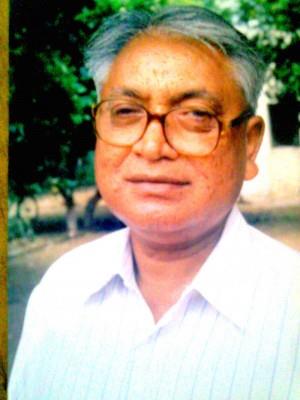
Tulsi Ram was born in 1949 in the village of Dharampur in Azamgarh District, Uttar Pradesh. His childhood and youth were shaped by hard agricultural labour, caste discrimination and superstition. Because of the visible scars and the blindness in one eye left by a smallpox infection, Tulsi Ram suffered more than the other Dalits around him from the prevailing discrimination.
Already in childhood, Tulsi Ram recognised education as a possible way out of the poverty of village life, and he fought his way to it, even though this repeatedly led to rifts with his family. After primary school, he attended the D.A.V. Inter-College in Azamgarh, even though his family was strictly opposed to it. The family's disapproval rested on their superstition and on the influence of the Brahmins of his home village, according to whom too much learning in a boy of his descent would bring on madness.
After the Inter-College came Banaras Hindu University and a doctorate in international politics. Since childhood, Tulsi Ram had been fascinated by the communist programme and by the principles of Buddhism. He named as his personal role models the Buddha, Karl Marx, and the social reformer Bhimrao Ramji Ambedkar, himself a Dalit activist. Tulsi Ram's religious and political role models shaped his academic career. He last worked as a professor at the Centre for Russian and Central Asian Studies of the School of International Studies at the renowned Jawaharlal Nehru University. His special subject areas included Marxism and international politics — with particular attention to the Soviet Union — as well as Buddhist and Ambedkarite perspectives on both.
Tulsi Ram processed the experiences he had in his life — both positive and negative — in literary form in his autobiography. After initially appearing as seven separate instalments in the literary magazine Tadbhav, these were published as a stand-alone book in 2010 under the title Murdahiya. It covers the years 1949-66, that is, Tulsi Ram's childhood and youth up to the completion of secondary school and his entry into the Inter-College. Murdahiya refers to the ritual cremation and burial ground of his home village. The discrimination and exploitation by higher castes he describes, along with the bitter poverty of his own origins, are the reasons why Tulsi Ram refers to his young life as a metaphorical Murdahiya. Despite its strong association with death, however, the author does not associate this place solely with negative emotions and memories. He describes this place as central to life within the Dalit settlement, where livestock also graze and which, at times, served as a refuge for the young Tulsi Ram. This reflective view of the cremation ground, in all its facets, is characteristic of Tulsi Ram's entire writing style. Within the text there are no pessimistic or self-pitying passages. Instead, he portrays his childhood and youth in an objective depiction of reality, harsh in its cruel details yet at times conciliatory and humorous. In doing so, Tulsi Ram narrates from an adult's perspective, detached and reflective, which allows him to expose the ills of his social environment — the prevailing double standards, superstition, hypocrisy, or corruption.
Manikarnika, the title of the second part of Tulsi Ram's autobiography, is the name of another cremation ground, the famous cremation ghat on the banks of the Ganges in Varanasi. The second volume was published in 2014 and deals with his years as a student and his growing political engagement. Tulsi Ram's early death, on 13 February 2015 in Delhi, prevented the publication of the planned third and final part of his autobiography.
Lisa Scholz
Literary Works
Autobiography:
- Murdahiya (मुरदहिया), Delhi: Rajkamal Prakashan 2010
- Manikarnika (मणिकर्णिका), Delhi: Rajkamal Prakashan 2014
Published in German
- Murdahiya. Eine Dalit Kindheit, translated by Almuth Degener. Draupadi Verlag 2020 (in German)
Reviews
📄 Download this author profile as a PDF (in German)