O.N.V. Kurup
About the Author
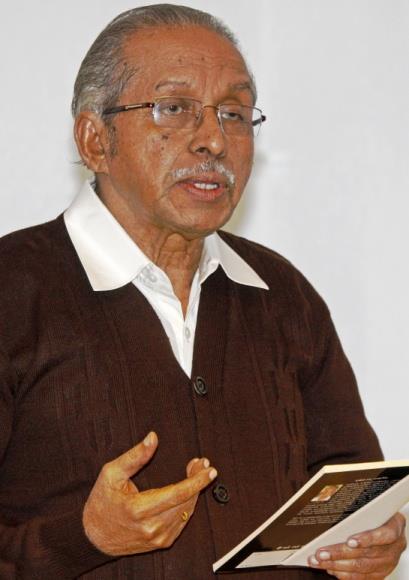
Ottaplackal Nambiyadikkal Nilakantha Velu Kurup (mostly known simply as O.N.V.) is one of India's best-known contemporary poets. Readers and literary figures honour him as a leading voice and one of the most important poets and essayists of classical modern contemporary literature in Malayalam (the official language of the state of Kerala and the union territory of Lakshadweep). Praised as "a humanist among poets and a poet among humanists" (Satchidanandan), O.N.V. received numerous national and international honours (for example the Jnanpith Award, India's highest literary prize, in 2007, and Russia's Pushkin Medal in 2015). He belongs to India's progressive poets' movement and is its representative in Kerala.
O.N.V. Kurup was born on 27 May 1931 in the village of Chavara in Kollam (Quilon) on Kerala's west coast. He was introduced to Sanskrit and Malayalam by his beloved father, whom he lost at the age of 8. He grew up with his mother in her family. After studying economics (in Kollam) and Malayalam literature (in Thiruvananthapuram), he worked from 1957 to 1986 as a lecturer and professor at several colleges and universities in Kerala. He lived with his wife and two children in Thiruvananthapuram, the capital of Kerala, where he died on 13 February 2016 at the age of 84. He was honoured with a ceremonial state funeral.
Works
Kurup left behind 35 volumes of poetry, as well as speeches, essays and a large body of film lyrics. A representative collection of his poems is contained in the 1,624-page volume O.N. Vyute Kavithakal Oru bruhatsamaharam, 1946–2010, D.C. Books, Kottayam 2001/2011 — an impressive testimony to his creative output. Three phases can be identified in the development of his poetry: the early Marxist-communist-revolutionary phase; a second phase of more discerning creative work, matured through experience; and a third, reflecting in retrospect, in which he commits himself to the greatness of humanity and the great idea of humanism, without, however, abandoning India's cultural and religious heritage.
His early revolutionary poems (1946–1956) are collected in the volume Dahikkunna Panapatram ("Thirsting Chalice", 1981), including Arivalum Rakkuyilum ("Sickle and Nightingale") and Mattuvin Chattangale ("Change the Old Orders"). Kurup's disappointment over communist China's attack on neutral India in 1962, and his unsuccessful attempt to stand as a candidate in the 1989 parliamentary elections, contributed to his later works becoming more critical and reflective.
Classical material is estranged in order to give shape to present-day conflicts and social problems. A modern, reflective attitude and psychological subtlety come together in his work Bhumikkoru Charamagitam ("A Requiem for the Earth", 1984), a lament over the desecration of Mother Earth, or of nature, and a testimony to his ecological awareness and expanded poetic humanism. The poem remains the immortal voice of the then-successful ecological movement, that is, of effective environmental-political engagement in Kerala. The metaphor of the earth also stands for woman and the female body.
The revolutionary fire of the early poems becomes, in Suryagitam ("Song of the Sun", 1984), the liberating presence of the sun of the poetic word. The two poems A Requiem for the Earth and Song of the Sun mark the high point of Kurup's œuvre. These two "beacons for world literature" have been translated into many languages of India and abroad (including German — see Ein Tropfen Licht, pp. 23–29, 48–51). The epic poem Ujjaini (1994) takes up the biography of the Sanskrit poet Kalidasa.
Swayamvaram ("Free Choice of Husband", 1995), also an epic poem, is dedicated to the women of India. In this poem, Kurup offers a critical, fearless diagnosis of Indian male society, a bold reinterpretation of an episode from the epic Mahabharata.
O.N.V.'s numerous lyrical film songs also enjoy great popularity.
Musicality and rhythm underlie almost all his poems. Kurup therefore placed great importance on the recitation of his poetry.
O.N.V. Kurup visited Germany several times, giving poetry readings at, among other places, the University of Bonn, the Tagore Institute in Berlin, and the universities of Cologne and Heidelberg. He also presented his poetry in numerous countries of Western and Eastern Europe, Asia, and in the USA.
Annakutty Valiamangalam K.-Findeis
Published in German
- Ein Tropfen Licht. Gedichte, edited and translated from Malayalam into German by Annakutty Valiamangalam K.-Findeis, Draupadi Verlag 2012
Further Articles
- A.V.K. Findeis, "O.N.V. Kurup", in: Kindlers Neues Literatur Lexikon. Supplement 21, A–K. Munich 1998, pp. 772–774 (in German)
- Same author, "O.N.V. Kurup und seine Dichtung". In: Meine Welt, issue 2/12, December 1995, p. 7 (translation: Aksharam). The Meine-Welt issue for download (PDF, in German)
- Andreas Weiland, "K. Satchidanandan und O.N.V. Kurup: Zwei Generationen und zwei Varianten engagierter indischer Dichtung", in ORIENTIERUNGEN: Zeitschrift zur Kultur Asiens 28 (2016), pp. 309–316 (in German)
Reviews
- Heike van den Bergh, "Ein Tropfen Licht", in Migrapolis Deutschland, 26.11.2012 (in German)
- Andreas Weiland: review of Satchidanandan and Kurup (PDF, in German)
📄 Download this author portrait as PDF (in German)